Beaded Chainmaille Tutorial – Beaded Chainmaille Bracelet
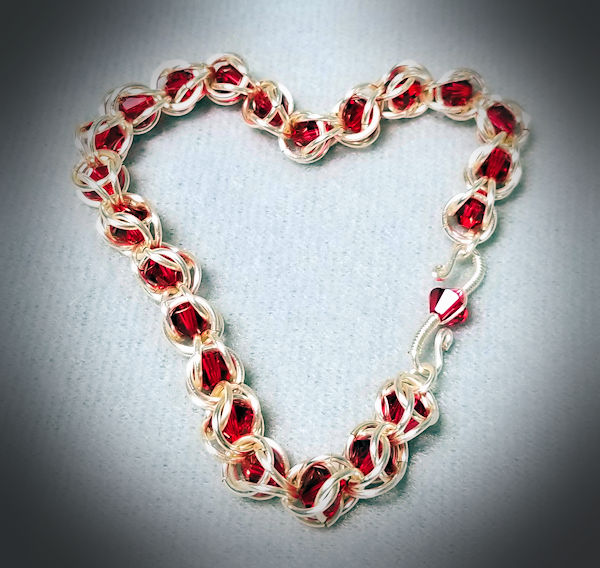
Beaded Chainmaille Bracelet
A beaded chainmaille tutorial you ask? Well, you did ask, so here’s the first of my projects! The beaded chainmaille bracelet jewelry video tutorial is below, but before we get there, let’s talk about jump rings a bit more first.
Jump Rings 101 (Short Version)
I do have a more in-depth post and free PDF about jump rings, but let’s do a quick overview, so you can make sure you have the right rings for the project.
The two most important items are wire gauge (how thick the wire is) and the inside diameter (ID) of the rings. I tend to use 18 gauge wire most often, for the following reasons:
- It’s sturdy enough to not warp easily.
- It has a thickness of 1mm. (Ok, it’s officially 1.02mm, but close enough.)
That means that if the rings I am buying has the size listed as outside diameter (OD), all I have to do is subtract 2mm from that to get the ID. That makes it easy to know the aspect ratio (AR) of the rings — and for that I will have you see the above link for the nitty-gritty details. 😀
Jump Ring Sizes for the Beaded Chain Maille Tutorial
For the project, you will need 18 gauge jump rings that have an ID of 6mm. You can go as low as 5.9 or as high as 6.5, but 6mm is the “sweet spot”. You’ll also need some smaller rings for the ends — I think the ones I used were around 4mm, but you could use 3.5mm if that’s all you have. And if you only have the 6mm rings, you can use those as well! I just happen to like smaller rings for the ends.
Beads for the Project
For the beads, I highly suggest you use 6mm bicones. The reason is that the bicone shape lets the beads “snuggle down” and lets the top rings close easily. While you can use fire-polished or round beads, I don’t suggest you use them for this particular project — they make it very difficult to get the top rings closed.
(I will shortly have another beaded chainmaille jewelry tutorial that can use fire-polished or round beads – I’ll put the link here as soon as it’s done.)
Clasp — What to Choose?
The clasp is whatever you want to use. I made an S clasp, one that uses the same bead as in the bracelet. There is nothing stopping you from using anything else, though. If you want some ideas for making your own clasp, check out my clasp-making tutorial post.
Ready, Set — Here’s the Video!
Without further ado, here’s the video for the beaded chain maille jewelry tutorial — I hope you enjoy it!
How to Make a Clasp — Clasp Ideas You Can Make Yourself
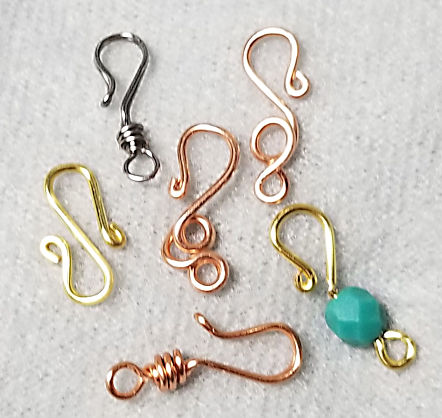
Examples of Clasps
How to make a clasp…is it difficult? No, it’s not, as long as you have some wire and feel like playing! Making your own clasps gives you the opportunity to customize your jewelry even further. It also helps when you realize you don’t have a clasp the right size, LOL. You can make one just as large or as small as you need!
Clasp Wire – What Gauges to Use?
Ideally, you would use 18 gauge or 16 gauge for any clasp design that is made from a single wire (as opposed to some clasps which have a doubled wire). Most often, I use 18 gauge wire, and I will work-harden it afterwards with a rubber mallet or a chasing hammer. However, I don’t always need to do the work-hardening for 18 gauge, especially if my jewelry project is lightweight.
If I have a design that uses doubled wire, I tend to use either 20 gauge or even 22 gauge.
If I have a design that uses any wire weaving techniques, 20 gauge is my favorite, as the wire weaving stabilizes the wire.
Now most jewelry wire is sold as “dead soft”, which is ideal for shaping. However, if you don’t want to fiddle around with work hardening your 18 gauge wire, you can try using half-hard wire. It’s more difficult to shape, but it holds that shape well.
Keep in mind that when I talk about gauges, I am referring to the “AWG” gauge, which is the traditional measuring system for jewelry wire. If you pick up some wire listed as “SWG”, keep in mind that anything under 20 gauge has a different wire diameter — it’s generally one size larger than AWG. It makes a difference as to how easily the wire bends.
Time to Make Some Clasps!
Here’s a video on making clasps — just a few ideas. These are fairly simple, and meanwhile, I am thinking up some other designs that are a bit more elaborate, for when you want that extra-special touch!
How to Make a Tassel – Making Silk and Embroidery Floss Tassels Video
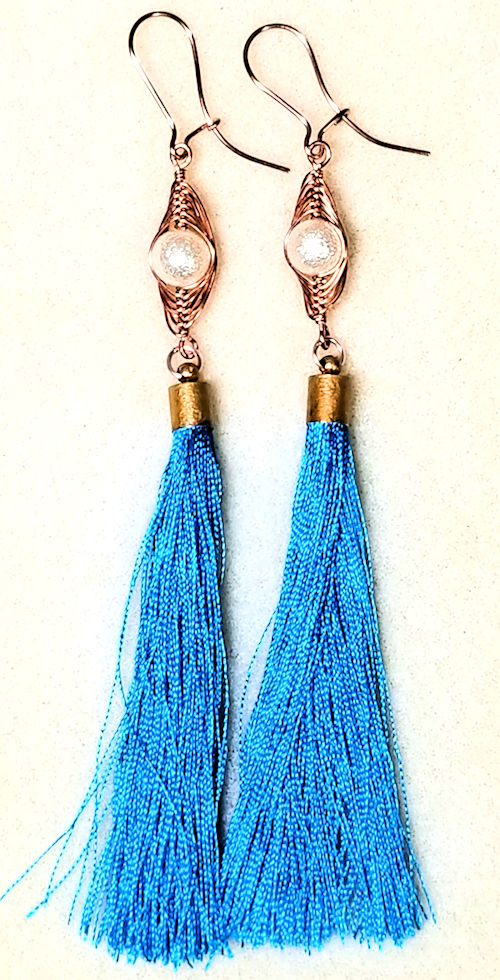 How to make a tassel – this video has some instructions and insights into the fun jewelry art of tassel-making! I’ve seen a lot of jewelry lately featuring tassels – especially silk. Sooooo, I got some silk, rounded up some embroidery floss and embarked on the tassel-making journey.
Then, I thought, why stop there? What about some other beading threads I had laying around — how would they work? Well, I pulled out some of those and tried them out — with various success, as you will see, LOL.
Why Make a Tassel?
Why make a tassel? I guess the question is why not make some? I’ll admit, I never quite saw the charm of them, until I realized how comfortable they are for earrings — very lightweight, when made with silk. You can get those shoulder-dusters without pulling down your earlobes. I don’t know about you, but I’m sensitive to heavy earrings; I have a hard time with them, so I gravitate to smaller ones. Well, problem solved!
Uses for Tassels — They Aren’t Just for Jewelry
I’ll admit, I mostly use them for jewelry. But in making the video and trying out different kinds of thread, I wondered what else they might be used with.
Some obvious items would be chain pulls and edging for lamps. Pillows too — they could use a tassel edging. But what about Christmas tree ornaments? I can see them hanging down, either attached to some regular glass balls, or on their own.
Small tassels could be used for key rings, although I’d probably use leather for those.
What about adding them to tote bags, either as a stand-alone or maybe all around the edges? And of course there is the option to add a tassel as a “charm” to your handbag.
Oh, and I forgot about adding them as accents to your drapes — that is another use that has been in vogue.
Still, my favorites are jewelry — but then again, a lot of what I am and do is somehow related to jewelry. 🙂
Video Tutorial – Get Comfy and Get Watching
OK, so here’s the video. And in case you were wondering, the end caps I used were either 4mm (smaller tassles) or 8mm (tassel with the charm). I got a boatload of them from Amazon for a very inexpensive price — like $10 or so. Since they are all the same shape, I’m working on ways to alter them so they become part of the jewelry, instead of just something to hold the tassel. But — that’s a whole other video!
https://youtu.be/L3xVHjDxSUI